



Do you ever get that uneasy feeling when someone says “thank you for your patience”? What patience - do I ask myself? Lately I have been collecting customer service experiences, and several of them were not so great. Usually I don’t name any names, but in this post I’m going to be brutally honest with a few premium brands.
My Dyson vacuum battery died after 11 months. My Ozlo Sleepbuds died at exactly the same age, which was especially upsetting because I’d already been through several warranty replacements of Bose Sleepbuds, which Ozlo promised to improve. Amazon sends me somewhere around 100 emails a month but apparently didn’t think my automatic Prime renewal deserved one, so I cancelled. Udemy managed to annoy me through both its Trust & Safety process and Instructor Support, while Equinox took several weeks to answer a fairly simple question about my ever increasing membership rate. Oh, and Odd Bunch failed to deliver my order on time and when it finally did show up the raspberries were crushed.
Mistakes are made all the time, and that’s just part of life. The question is: what happens next? When a company messes up, how do they make it right? When the original frustration turns into a customer service nightmare, that adds insult to injury. The good news, out of the list above, OddBunch ended up surprising me the most. Keep reading to find out why.
Eleven months is a dangerous age
Dyson sells vacuum cleaners for about $1,000 or more (each). Their machines need monthly maintenance and regular filter replacements. For a vacuum cleaner, it’s more demanding than Roomba and I still have to do the actual vacuuming myself. Despite all that maintenance, after 11 months the battery died anyway.
Sh*t happens: batteries and electronics fail all the time, and more expensive products aren’t magically exempt from any of those issues. The real issue is what happens after something breaks. Getting warranty service from Dyson was complicated, and that’s where the premium branding starts to work against them. If I’m paying premium money for a product, I’m expecting premium service. In most cases that means making my experience painless, even when something does go wrong.
Similarly, my Ozlo Sleepbuds also started having connectivity issues after 11 months. I had similar problems with the Bose Sleepbuds before, and Ozlo was supposed to be the improved version.1 Yes, I lost sleep over not having them available. After 2 weeks of back and forth, Ozlo required me to send the failed pair back before they would send the replacement. Not convenient for a health-related product people may actually count on.
Answers that don’t really answer anything
When I contacted Instructor Support at Udemy about a noticeable decline in my course sales on their platform, I wasn’t expecting them to magically generate more sales overnight. That would have been nice, but what I really wanted was some information about the overall trend and direction of the platform. The initial response gave me a carefully worded canned reply about fluctuations in promotions and more generic marketing resources. They never answered my question.
Participating in somebody else’s platform can be great, but there’s always the risk the platform changes in a direction that doesn’t align with your values. This experience, and a few others leading up to it, became one of the reasons I started Windmill Cloud so I could share my learning content from my own platform.
Premium is easier to put on the invoice
Then there’s Equinox. I’d seen a newly advertised FoundersCard benefit and contacted them to ask whether it could improve my existing membership rate. I’ve been an Equinox member for several years, and instead of being grandfathered in to my original rate, it keeps going up every year. It took several weeks to get an answer, but eventually they confirmed in a very brief email that my current monthly rate was the best they could do.
If that’s the rate, fine. It’s expensive as a gym, but the classes and amenities make up for it - to a point.2 My disappointment was how long it took to get an answer to a fairly simple question. Why is it that service feels surprisingly ordinary when everything else a brand says about themselves is “premium” and “luxury”?
Amazon on the other hand, has no problem sending me hundreds of emails. I get individual order and shipping confirmations, sometimes for each individual item I’ve ordered. Yet somehow they did not think to send me an email about my automatic Prime renewal: they just charged my credit card. I think one additional reminder email would’ve been fine. At the lack thereof, I cancelled Prime.3
The sign at reception
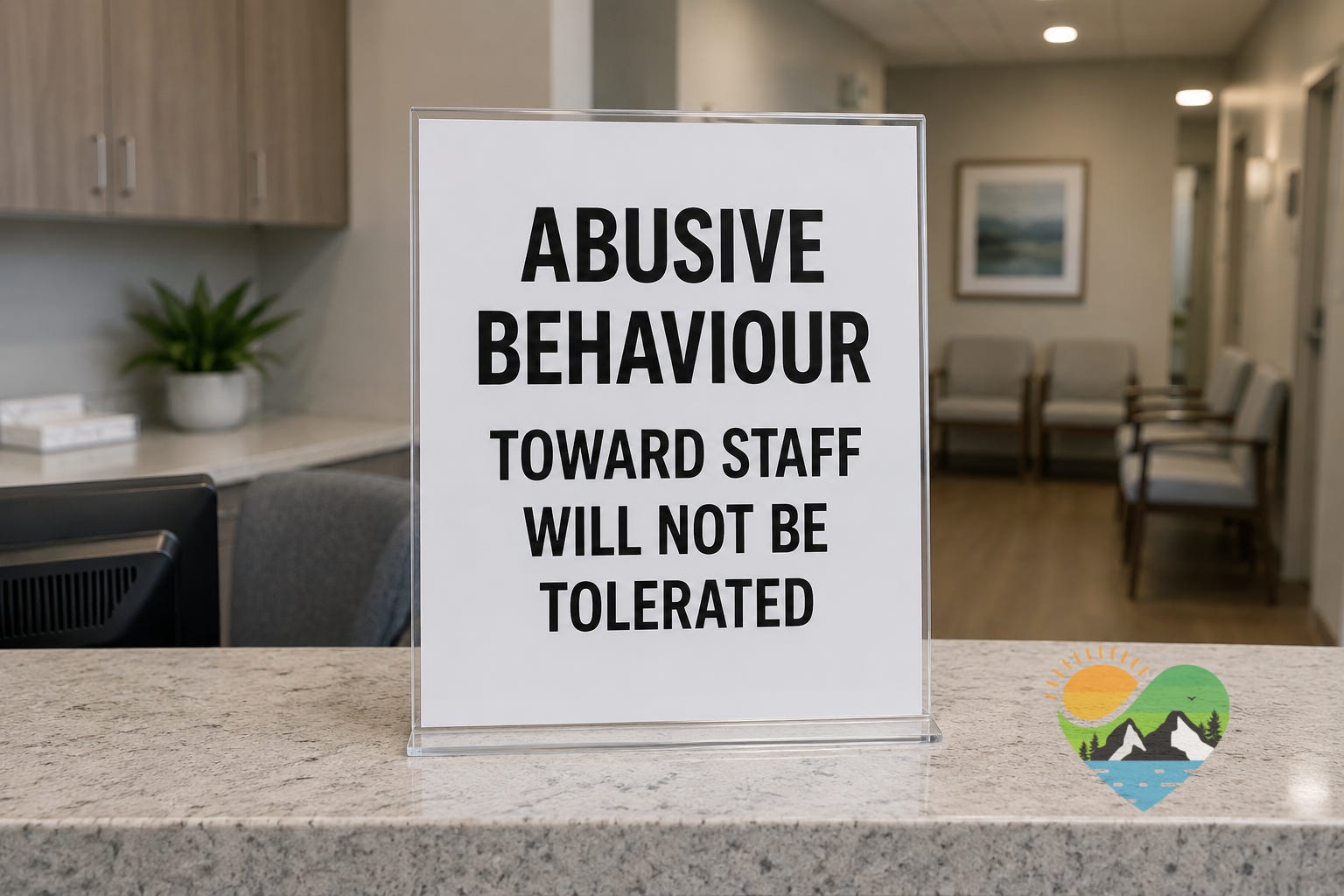
I recently needed to go to a medical clinic which had a sign saying “abusive behaviour toward staff will not be tolerated”. I agree with the sign and nobody working in customer service of any kind should have to tolerate abuse from customers.
Those signs always make me wonder what the level of service is in places like this. Nice restaurants or spa’s typically don’t display them, but you do see them at cheap take-out places and walk-in clinics. In my case, the receptionist couldn’t have been much further detached from creating a welcoming experience. That doesn’t excuse anyone behaving badly, and sometimes customers are simply rude. I’m not making excuses for poor behaviour - however that does go both ways. Organizations sometimes overlook the experience they created before the customer became difficult.
One of the things I teach in my Customer Service course, is that by the time the customer gets to you, they’ve likely already tried everything themselves. Now, they’ve run out of options, and are probably tired and frustrated to some degree. The beauty of customer service is that you get to turn that negative experience around, and that’s an art.
Odd Bunch got it wrong right
Odd Bunch messed up my order on the same day I wrote about them, which was obviously annoying. If you’re trying to save “odd” produce, the care level for that produce should be reflected in the delivery process too. My raspberries suggested otherwise that day. Apparently I wasn’t the only one, and within about a week, they changed delivery providers. I’ve had zero issues since.
Taking action impressed me more than an apology email alone. They looked at what had gone wrong and changed something. That didn’t fix my raspberries, but it has made a difference for every delivery since. It’s refreshing when a company dares to own up to their mishaps and tries to be better.
The original delivery still failed. Good customer service didn’t somehow make that disappear. What it did was change my opinion of the company because the response showed ownership. Oddly enough, I probably thought more positively about Odd Bunch afterwards than I would have if the box had simply appeared at the door as expected and I’d never given them another thought.
Service is a Mindset
All my examples centre on a single theme: service is a mindset, not a department. If done right, you realize that everyone works in customer service and contributes to the end-to-end experience.
As customer, I’m dealing with one company. How you organize your departments to get the work done is up to you. By the time somebody contacts the actual Customer Service department, much of the customer experience has already happened. What matters at that point, is what happens next.
I soft-launched my new Customer Service Course a few weeks ago, and these experiences have been an oddly well-timed reminder of why I wanted to create it. If you’d like to look at how the service experience gets created throughout the business by implementing a mindset instead of a process, please feel welcome to check out this brand new program. Especially if your company was featured in this post, I'd love to have you on board! 😊

Further reading


I checked before ordering mine 11 months ago, and received this reply: “After going through 4 or 5 sets of Bose Sleepbuds, I’d be feeling the same way. It’s frustrating when something that’s supposed to help you sleep ends up being unreliable. That’s actually why Ozlo exists. A lot of us on the team were longtime Bose Sleepbuds users too, and we knew the concept was amazing—it just needed to be built to last. So we took everything we loved, fixed the pain points, and really focused on long-term reliability. (…) and I’ll be here if anything ever comes up.”
I’m not sure how many more annual increases I can take to push me past a breaking point in my budget.
Cancelling Prime had a few interesting side-effects. Most of my orders still ship for free, as I just leave items in my cart until I meet the minimum order value to qualify for free shipping. This means less impulse-buys. Secondly, more of my credit card charges and email confirmations since have been for the total order, instead of individual items, which I thought was an additional nice-to-have.