


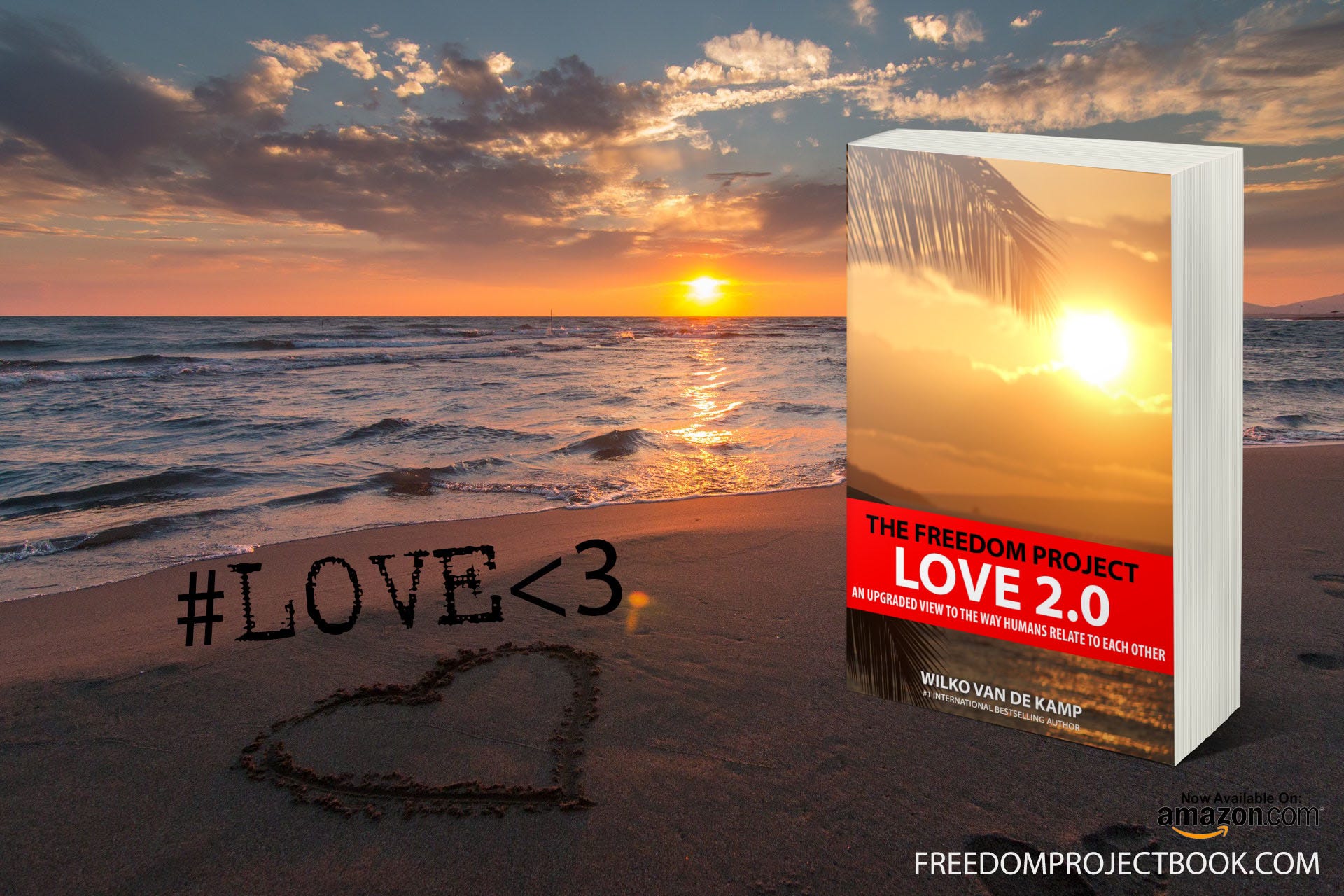
Eight years is a long time for a book to exist in the world. Long enough for the cover on the shelf in my office to feel familiar and slightly foreign at the same time. Long enough for readers to have found it, ignored it, underlined it, forgotten it, or possibly used it as a coaster under a glass of wine by now. Cheers to you, I try not to take that last option personally.
When The Freedom Project: Love 2.0 first came out, I knew it was going to be a different kind of book for me. Travel is easy to talk about, we all do it, all the time. You can complain about airports, wrong turns, bad hotel rooms, missed connections, and the weirdly emotional relief of finding decent coffee somewhere unfamiliar. But Love is messier.
Not the Instagram version of love, where everyone looks suspiciously well-lit and nobody has ever argued about logistics, money, family, exhaustion, or whose brilliant idea it was to leave the house late. I mean the everyday version of love: the part where belonging, expectations, disappointment, loyalty, compromise, and personal growth all get stuffed into the same carry-on bag. Until the zipper breaks.
That was the uncomfortable territory of Love 2.0. Eight years later, it still is.
This Book Was Never Just About Romance
The funny thing about a book with “Love” in the title is that people assume it’s about romance. Yes, relationships are in there, but I wasn’t interested in (or capable of) writing a manual for candlelit perfection. The world has enough unsolicited advice about date nights and communication hacks already.
Love 2.0 is about the question underneath: how do we live with other people without losing ourselves?
That question shows up everywhere. In friendships that slowly become obligations. In families where love and history are tangled together so tightly you can barely tell one from the other. In relationships where peace becomes more important than truth, until that “peace” starts feeling uncomfortably expensive. It’s finding an answer in the search for belonging, especially when the places or people that once felt like home no longer fit the same way.
Love 2.0 was never about creating or finding a perfect relationship, but about learning to pay attention to the patterns that shape how we connect, what we tolerate, and what we keep calling “love” long after it has turned into something else.
Eight Years Is Enough Time to Notice What Holds Up
Relationship lessons age differently. Yes, people change, but we also keep being people with impressive consistency. We still want to be seen. We still confuse attention with connection. We still avoid difficult conversations and then act surprised when the bill arrives later, with interest. We still want freedom, but we also want belonging, and we are often not honest about how much both of those things cost.
Looking back at Love 2.0 after eight years, I don’t see a book that solved anything, but a book that tried to name a few tensions honestly. I don’t think the reader wants a tidy answer. Sometimes it’s just about giving language to something they already felt but had not yet admitted out loud.
Love Is Not an Escape From Personal Responsibility
Love does not excuse us from doing our own inner work. It, unfortunately, does not always rescue us from self-awareness. It also does not make poor boundaries noble just because they are wrapped in good intentions.
We expect relationships to provide certainty, identity, comfort, validation, and sometimes a full-time emotional support department with no lunch breaks. Love can carry a lot, but it should not be asked to carry everything. At some point, the romantic idea of “you complete me” starts to sound less like devotion and more like a staffing problem.
Relationships require a certain kind of accountability for our own patterns. Our human tendency to repeat what is familiar, even when familiar is not the same as healthy. That kind of ownership is not very Instagrammable as it rarely photographs well. But it changes everything.
Belonging Should Not Require Disappearing
A major theme in Love 2.0 is belonging in the different circles of life, and I think that theme has only become more important. We live in a world where connection is everywhere while loneliness spreads like a disease. We can message anyone instantly and still feel isolated and unseen. We can belong to groups, platforms, networks, communities, and comment sections, while quietly wondering whether any of it is real.
Belonging is one of those words that sounds warm until it starts demanding payment. Sometimes the price is small: a bit of compromise, a shared rhythm, a willingness to care about things may not naturally interest us. That is part of living with others, and can be a good thing. Yet sometimes the price of belonging is too high. We begin editing ourselves into a more “acceptable” version. We keep quiet to preserve the mood. We confuse harmony with silence. We trade honesty for approval, then call it maturity because that sounds better than fear.
Eight years later, this still feels like one of my hardest lessons. Real love should give us more room to be ourselves, not less. It should challenge and refine us, yes. It should occasionally irritate us into becoming better people. But it should not require us to disappear.
The Book I Wrote Then, the Person Reading It Now
One of the odd gifts of writing books is that they become a letter to your future self. Not like a diary; a book is shaped, edited, structured, and hopefully made readable for someone who does not live inside the author’s head. (Lucky them.)
Still, when I look back at Love 2.0, I meet a version of myself who was trying to understand relationships in all areas of life with the tools I had at the time. Some of those tools have gotten sharper over time. Some assumptions have softened. Still some questions remain unresolved, which is annoying but probably honest.
We sometimes expect old creative work to represent us perfectly forever. If something I wrote eight years ago still reflects exactly how I see everything today, then either I was unusually wise back then or I have done zero useful thinking since.
What I appreciate now is not that Love 2.0 captured a sincere attempt to understand love as part of freedom, not separate from it. That idea still feels right today.
Love and Freedom Are Not Opposites
A lot of people talk about freedom as if it means having no obligations, and no commitments. There is some appeal to nobody expecting anything from you, especially after dealing with international bureaucracy, family logistics, or a relationship conversation that begins with “we need to talk.”
Freedom without connection is often empty inside. And the opposite, connection without freedom, can become suffocating. The answer lies somewhere in the middle. How do we build relationships that support a life with more freedom rather than shrinking it? How do we choose people, places, and commitments that make us more honest, more capable, more alive? How do we stop treating love as either a cage or a rescue boat?
That is where Love 2.0 belongs within The Freedom Project. It is not a detour from the freedom conversation. It is one of the more difficult chapters of it. Because freedom is not just the ability to travel, work differently, or design your own schedule. It is also the ability to relate to others without abandoning yourself.
Get Into Action

Eight years after The Freedom Project: Love 2.0 was published, I’m less interested in celebrating the book as a finished object and more interested in the questions it still raises.
Where have you confused peace with avoidance?
Where has belonging started to feel a little too expensive?
Which relationships give you more room to become yourself, and which ones quietly ask you to stay smaller?
Those are not questions to answer in a hurry. They are better carried around for a while, perhaps on a long run/walk, over coffee, or during one of those inconveniently honest moments when life refuses to stay neatly organized.
If this reflection stirred something useful, The Freedom Project: Love 2.0 is still available today for new readers who still want to explore love, belonging, harmony, and personal growth without pretending any of it is easy. Eight years later, I still think that is a conversation worth having.


